

Flour labels can be confusing, but the main differences are fairly simple. If you are trying to make more informed choices in the kitchen, it helps to understand a few common terms: refined, whole wheat, white whole wheat, bleached, unbleached, enriched, bread flour, and bromated.
For most home cooks, the goal is not to memorize every flour type. It is simply to know what you are buying and choose the option that fits your priorities.
What is refined flour?
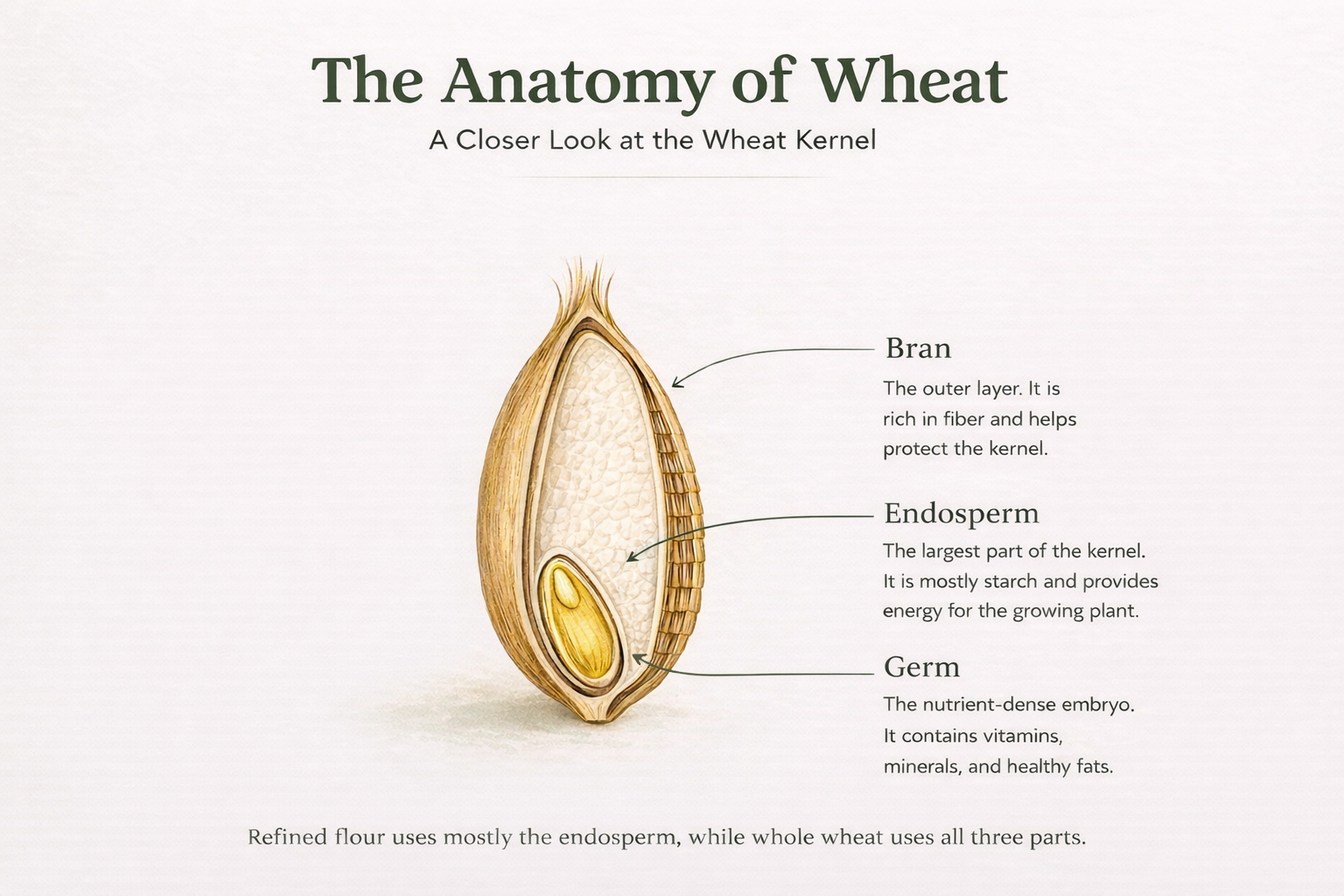
Refined white flour is made by removing the bran and germ from the wheat kernel and using mostly the endosperm. This creates a softer, lighter flour that works well in many baked goods, but it is more processed than whole grain flour.
You will often see refined flour used in products like white bread, crackers, cookies, pastries, and cakes.
What is whole wheat flour?
Whole wheat flour uses all parts of the wheat kernel: the bran, germ, and endosperm. Because it keeps more of the grain intact, it is generally less refined than white flour and has a darker color, denser texture, and more pronounced wheat flavor.
What is white whole wheat flour?
White whole wheat flour is still a whole grain flour, but it is made from a lighter-colored variety of wheat. It has a milder flavor and softer color than traditional whole wheat flour, which is why some people prefer it for breads, muffins, pancakes, and other baked goods.
It can be a useful middle ground if you want the whole grain structure with a less heavy taste or texture.
Bleached vs. unbleached flour
This is one of the most common points of confusion.
Unbleached flour is flour that ages naturally over time.
Bleached flour is treated to speed up the whitening process and create a softer texture.
Both can be used in baking, but many people prefer unbleached flour when they want a simpler, less processed option. For everyday cooking, unbleached all-purpose flour is a good standard choice.
What does enriched flour mean?
When flour is labeled enriched, it means certain nutrients have been added back after processing. This is common with refined white flour.
That does not make enriched flour the same as whole wheat flour. It is still a more processed flour, but the enrichment process is meant to restore specific nutrients.
What is bread flour?
Bread flour is usually a refined wheat flour with a higher protein content than all-purpose flour. That extra protein helps develop more gluten, which gives bread more structure and chew.
It is not necessarily “better” or “worse” than all-purpose flour. It is just designed for a different purpose. If you bake yeast breads often, bread flour can be useful. If you are simply looking for a less processed option, that comes down more to whether the flour is unbleached, whole grain, or unbromated.
What is bromated flour?
Some flour is treated with potassium bromate, an additive used to strengthen dough and help baked goods rise higher. This is called bromated flour.
If you prefer to avoid potassium bromate, check the packaging or look for brands that clearly state they are unbromated.
What should you look for?
If your goal is to keep things simple, these are good starting points:
- unbleached all-purpose flour for everyday baking
- whole wheat or white whole wheat flour when you want a less refined option
- unbromated flour if you want to avoid potassium bromate
It is also worth reading ingredient labels on packaged breads, crackers, baked goods, and baking mixes. Terms like enriched wheat flour or bleached flour can tell you a lot about how processed the product is.
What to remember
Not all flour is the same. Some flours are more refined, some are less processed, and some are treated to change texture or baking performance. For most home kitchens, a good place to start is choosing unbleached flour and using whole grain options more often when they work for the recipe.


This is one of the best article one has to read on the internet this days. Your way forward “Eat whole graine bread” is the perfect words and it took me back to the good old days.
So I am from Addis Ababa, Ethiopia and in here we could easily and readily buy the wheat grain from any local stores not further than 10 miniutes walk. We also have a lot of local small scale grain miller’s (who often sell the grains anf mill too).
I am now 38 years old going to 39 my mom NEVER used a processed or bleached flour to make us a bread even if she could buy it easy and cheap. We grow eating a bread baked from whole grain wheat flour bought from her long time local Miller. The other point is she always preserve her own “Yest” from her previous dough and I didn’t remember she useing baking soda or purchased yeast.
That makes her bread special to me and to this datr I never experianced a bread that could match her’s even in a 4 star hotels.
Thank you for bringing this up and I am now your regular follower. Good night.
thank you for adding to the conversation Teshager!
Very interesting. But I for one can’t digest brans, whole wheat nor certain high fiber vegetables. I have seen GI doctors and have done various tests. One of the doctors explained to me that many people have this problem. A dietitian also told me that people who are very sensitive ro these fibers should stay away from them because it can only make my problems worse. I for many years was a fiber nut and vegetables. When I explained this to my doctor he let me know that too much of a good thing can also be damaging to some. He went on to explain that many fibers have a rough scrubbing effect on the GI that after a while people sensitive become worse and not better. My daughter had the same problem. Every doctor and nutritionist told her to look for these healthy products and just eat these and nothing bleached and etc. My daughter ended up in the hospital after a few years of following this “healthy “ diets. Finally she went to see an ND and he stripped her of all of these things. He changed her diet. Healthy but low on fibers, brans, etc. Today she has gained weight, which she had lost tremendously, and feels great and so do I. So it not fair to us that have these problems to say we are eating products that are killers because those products that are considered healthy were killing us and spending a lot of money in doctors and other health professionals.
Thank you for this short but very informative article. As a rule I avoid white flours and stick w/sprouted grains, also bake treats with Almond & Coconut flours, it takes practice, of course also replacing sugar with Monk fruit, honey, bananas and the like. The healthier you ingest the better you feel & your body will thank you. Again thank you.
You said ” I had heard whole grain or whole wheat was better. But what I DIDN’T know was how truly harmful they actually were to me and my family!” Then later you said “Eat whole wheat breads, rye breads.” Can you explain why it is harmful, but yet you advise they are the best to eat?
Thank you. I like to bake but been using king Arthur’s flour because it does not contain all those harsh chemical. I also stop using sugars, eggs in my cakes but instead use natural sweets. I try very hard to stick with natural ingredients that God created because he created me and kniws whats better for my body. I am no longer over weight and feel so much better health wise. Thank you again for posting this ino.
I believe in all this. But you’ve got to take it one step further to make the whole grain / whole wheat flour useful. If you will use natural yeast (the stuff mankind has used for centuries to make bread and other good stuff from good flour) instead of this horrific baker’s yeast which does NOT fully process the gluten and fully develop the whole wheat four… you will get bread most anyone can eat. Allergies to wheat flour will go away. Natural yeast… often referred to as a sour dough start… doesn’t have to have that extreme tang. You can bake very mild bread, fully developed with whole wheat flour. The best stuff I’ve ever tasted.
That is the way my mom bake a bread to this day. She preserve her yeast from her previous dough. The taste is special. Thank you.
Awesome piece! Very helpful.
Wow! I had no idea about how flour is processed. I will share this with everyone I know! Thank you.
Not everyone can digest the bran and germ, especially people with D-prominent irritable bowel syndrome. I will say look for alternatives e.g. tapioca flour etc, I’m not a chef so I don’t know if it works though,
Thank you, this was a very helpful article but can you clarify whether it is only bromated white flour that kills bugs or all white flour?
i’m from africa we have a root plant called cassava that is good to make flour out of but what chemical is best to use to whiten the flour because i do not want to harm my people.
Fantastic….I have been wanting to read read about these types of flour. We hardly eat refined white flour. We always take whole wheat flour as per tradition. But it’s time to eat less refined food. We are switching Oils, Flours, Sugars etc. I will be switching to unbleached unbromated whole wheat flour.
Thanks for your guidance.
thank you for your comment 🙂
Thank you for sharing your findings. It is really disturbing and my stomach churned as I was reading.
wow! This is very interesting! Thank you for writing this article. It will help a lot with my science project.